from firstoffthebike.com
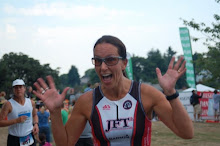
If there's anything that truly defines a triathlon it's the feeling of running off the bike. Whether you've just ridden to the shops or an Ironman bike leg your legs feel dead and heavy, and certainly not primed for running, let alone fast running. This form of running should almost have it's own definition with a similar distinction that "long distance running" has from "ultra running"...not to mention the associated sub-cultures that exist within essentially the same sport!!
How well you run off the bike also determines how well you finish, from age group sprint distance tris to ITU racing and up to Ironman. If you falter in the run leg there'll surely be someone running you down. Sometimes a "slower" runner will outrun a "faster" runner when thrown into a triathlon, which is another defining aspect of triathlons - a better **triathlete** can often beat a better **athlete**.
So, what contributes to running well off the bike, and what are the key criteria for doing so? The main components are fitness (bike & run), tactics, running form and psychology. Let's look at each of these.
Fitness
Fitness is the biggest determinant of your ability to run off the bike. Obviously, if you haven't done any run training then you can't expect to run well, full stop!!
Having said that, your fitness in other sports - swimming and bike riding - can benefit you in running, but consistent with the rule of specificity, the fitness you gain through run training is what will get you through in the long run (pardon the pun).
To contrast the relative benefit of each single-sport fitness - and the relative difficulty of each sport - only a few cyclists could run much further than a kilometre without exhausting themselves. However most runners could ride quite long and hard, albeit not necessarily very well. Running is by far the more demanding sport and by extension running fitness will be more beneficial to running well off the bike than cycling (or swimming) fitness.
Tactics
How you 'use' your relative cycling and running fitness - your tactics - also has a large influence in how you run off the bike. Most athletes have differing abilities between biking and running, even with similar relative fitness levels between the two sports.
Since the bike leg comes first, strong cyclists are often inclined to ride to the limits of their ability - which is usually faster than most - with small regard for the run leg ahead. Then, the longer the run leg the more they're likely to suffer from the extent of their exertion during the ride. Sometimes these kinds of triathletes can pull it off (eg, Normann Stadler in Kona '04 and '06) but more often than not they'll be passed during the run by athletes who rode more conservatively in order to run closer to their potential.
A simple example makes the point clear...if going 10 mins slower on the bike means you run 5 mins faster, then your overall time will be 5 mins faster. Basically, going a little slower on the bike will usually mean you run faster by a greater amount off the bike. The fact you might be strong bike rider doesn't change this model.
To use an analogy...countries having a nuclear weapon don't ever plan to use it.
Running Form
This is a favourite topic of mine, and as Fitness is related to Tactics, so Running Form is related to Psychology of running off the bike. Running off the bike differs little from 'open' running, although in general it more closely resembles marathon running form than it does track running form. Either way, the basics of good running form still apply - I've previously written about this in "How to run".
In triathlon the efficient runner is rewarded with better running off the bike. Specifically, this includes the following:
* Limiting upper body motion - torso and arms.
* Holding your torso in an erect position which is more efficient to maintain.
* Slightly shorter steps, although this is only to ensure running cadence is around 90-95 per leg per min (generally speaking).
* Minimising vertical movement.
At ITU level it is found that the best runners run at a cadence of about 10 less than they ride at, which links back to tactics on the bike in the gears you ride. It's very difficult to increase your run cadence off the bike, so you're better off riding at a higher cadence in the first place your most recent muscle memory when you start running is at/near that cadence.
The alternative is a slow run cadence, which implies / leads to over-striding which is closely related to poor running form. Because it's a triathlon shouldn't dramatically change your running form.
Psychology
When things get really tough, such as in and half or full Ironman is where running form can really go to pot, and where athletes can tend to "give in" to the circumstances and go into a survival mode of dropping their head, rounding shoulders and back, tilting hips back and basically neglecting most of the most basic aspects of running form.
Even in sprint and Olympic distance events - which are not long races by any means - there's a large number of people who "cave in". I suspect that numerous people have the mindset that "this is a triathlon and I'd doing it tough", and so their body language follows suit and they're almost waving the white flag before even giving themselves a chance to run well.
In this case a change in perspective would help. Think of a triathlon run leg as just a run with a swim and ride beforehand - it is not a world of torment and torture. Remember the fundamentals of running well, the basics of efficient running form and all the things you've done in training many times over. Concentrate, relax and don't be defeated by the scenario.
Psychology is especially important when the weather warms up. Yes, heat does mean a slower pace but it does not mean that survival mode is the only option. On these days it's the people who run positively and with confidence who stand out from the crowd, both in terms of strong running form and actual running pace.
Psychology during the run leg - as well as the whole triathlon - can make a huge difference to your performance, and how well you deal with situations that arise during a race. For running off the bike, a positive mindset is key to running well.
In summary, running off the bike will always be a little slower than 'open' running. But there are still many similarities and the fundamentals don't change. How well you can perform those fundamentals, and maintain them, is the key to running well off the bike.
Tuesday, August 17, 2010

Sunday, August 15, 2010
Quote for the Day
|
Wednesday, August 11, 2010
Fitness Fallacy
From Joanna Zieger's blog - Fast at Fourty (which is an awesome blog!)
This article was written with Dr. Phil Skiba, my coach and an extremely nice guy (http://www.physfarm.com/)
“I don’t want to lose my fitness” is perhaps the most commonly uttered statement by triathletes. I have no actual data to support this, but given the number of times I have heard it (and expressed it myself) I am reasonably confident that it must be true.
I think triathletes have a dreaded fear that between the time they close their eyes at night and awake in the morning they have lost inordinate amounts of fitness. A day off is a triathlete’s nightmare – we feel the fitness being sucked out of our bodies moment by moment.
The meaning of fitness varies from person to person. Are you fit because you can ride a century? Are you fit when you race to your potential? Are you fit because you can achieve most of your workouts?
No matter what your definition of fitness is, it does not disappear as quickly as the sunburn from your last race. Breaks in training occur for a number of reasons, whether it is from injury, work, travel or simply some needed time off. And, unless you have taken an excessive amount of time away from training, you are not going to come back as a deconditioned couch potato.
Here are the facts. Most people confuse the terms "fitness" and "performance status". In other words, when we perform well, we typically say we have a very high level of fitness. That is true, to a point. However, it is just a little bit more complicated than that.
When we train, our bodies become more fit, but we also get more tired. In the midst of a heavy training block, think about the yearning for that late afternoon nap or begging off dinner with friends because coming home at 10 pm is too late.
When we train or race a lot, our fitness becomes somewhat "masked" by how beat up we feel. The perfect example is the post Ironman fatigue and soreness syndrome. You couldn’t and shouldn’t train in the days following an Ironman. This time off doesn’t mean you are losing huge amounts of hard-earned fitness. it's just that your fitness is being hidden by tiredness, which would lead to a decrease in performance status if you tried to race again too soon. (It’s also being hidden by the not-insignificant damage Iron-distance racing does to the body. It would not be unreasonable to consider yourself “mildly injured” and in need of recovery immediately following a long-course race.)
To perform well, consistently, you need regular bouts of rest. If you are going out and killing bike ride after bike ride, and run after run, you don't really know how well you can perform, because you are constantly fatigued. This is why athletes sometimes have a great race after a layoff due to that minor injury, work craziness, or interference from other life factors. The layoff allowed the athlete to shed a great deal of fatigue. This is why tapering for a race works. You shed your fatigue, preserve most of your fitness, and are then able to smash a race.
Now, if you were to do some fancy math, you would find that you did lose a small amount of fitness during a training layoff. However, if you are training a lot, this loss is tiny in comparison to how much fatigue you lose. Depending on the sport, the average age group triathlete can shed two thirds of their fatigue in between 2 and 7 days. In comparison, it can take longer than 30 days to lose two thirds of their fitness. Get the idea? Your fitness hangs around a long time.
In my own training, I can attest to this very notion of fitness hanging around. I took a break after the Rev3 debacle for some quality healing time. I started a comprehensive therapy program in the gym and when I restarted training, it was maintenance and sanity training rather than specific race training. Lo and behold, over the weekend I PR’ed a tough run.
It's a different matter if you have suffered through some major illness, of course. 7 days of absolute bed rest with the flu or something is going to have a much more significant effect in terms of loss of fitness and performance status
The take home message is "don't sweat the small stuff". Those couple of days you need to take off when the in-laws arrive probably just serve to help you really crush your next workout!
This article was written with Dr. Phil Skiba, my coach and an extremely nice guy (http://www.physfarm.com/)
“I don’t want to lose my fitness” is perhaps the most commonly uttered statement by triathletes. I have no actual data to support this, but given the number of times I have heard it (and expressed it myself) I am reasonably confident that it must be true.
I think triathletes have a dreaded fear that between the time they close their eyes at night and awake in the morning they have lost inordinate amounts of fitness. A day off is a triathlete’s nightmare – we feel the fitness being sucked out of our bodies moment by moment.
The meaning of fitness varies from person to person. Are you fit because you can ride a century? Are you fit when you race to your potential? Are you fit because you can achieve most of your workouts?
No matter what your definition of fitness is, it does not disappear as quickly as the sunburn from your last race. Breaks in training occur for a number of reasons, whether it is from injury, work, travel or simply some needed time off. And, unless you have taken an excessive amount of time away from training, you are not going to come back as a deconditioned couch potato.
Here are the facts. Most people confuse the terms "fitness" and "performance status". In other words, when we perform well, we typically say we have a very high level of fitness. That is true, to a point. However, it is just a little bit more complicated than that.
When we train, our bodies become more fit, but we also get more tired. In the midst of a heavy training block, think about the yearning for that late afternoon nap or begging off dinner with friends because coming home at 10 pm is too late.
When we train or race a lot, our fitness becomes somewhat "masked" by how beat up we feel. The perfect example is the post Ironman fatigue and soreness syndrome. You couldn’t and shouldn’t train in the days following an Ironman. This time off doesn’t mean you are losing huge amounts of hard-earned fitness. it's just that your fitness is being hidden by tiredness, which would lead to a decrease in performance status if you tried to race again too soon. (It’s also being hidden by the not-insignificant damage Iron-distance racing does to the body. It would not be unreasonable to consider yourself “mildly injured” and in need of recovery immediately following a long-course race.)
To perform well, consistently, you need regular bouts of rest. If you are going out and killing bike ride after bike ride, and run after run, you don't really know how well you can perform, because you are constantly fatigued. This is why athletes sometimes have a great race after a layoff due to that minor injury, work craziness, or interference from other life factors. The layoff allowed the athlete to shed a great deal of fatigue. This is why tapering for a race works. You shed your fatigue, preserve most of your fitness, and are then able to smash a race.
Now, if you were to do some fancy math, you would find that you did lose a small amount of fitness during a training layoff. However, if you are training a lot, this loss is tiny in comparison to how much fatigue you lose. Depending on the sport, the average age group triathlete can shed two thirds of their fatigue in between 2 and 7 days. In comparison, it can take longer than 30 days to lose two thirds of their fitness. Get the idea? Your fitness hangs around a long time.
In my own training, I can attest to this very notion of fitness hanging around. I took a break after the Rev3 debacle for some quality healing time. I started a comprehensive therapy program in the gym and when I restarted training, it was maintenance and sanity training rather than specific race training. Lo and behold, over the weekend I PR’ed a tough run.
It's a different matter if you have suffered through some major illness, of course. 7 days of absolute bed rest with the flu or something is going to have a much more significant effect in terms of loss of fitness and performance status
The take home message is "don't sweat the small stuff". Those couple of days you need to take off when the in-laws arrive probably just serve to help you really crush your next workout!
Monday, August 9, 2010
Hills: Sit or Stand?
by Joe Friel
Saturday, July 3, 2010
Basic Skills for Group Riding
By Gale Bernhardt
You don't have to be a competitive cyclist to enjoy the benefits of group rides. Utilized correctly, regular group sessions can motivate you, improve your fitness and make any ride more enjoyable. However, if you lack the technique or the fitness to ride with a group, the experience can be frustrating and leave you riding alone. In a worst case scenario, lack of skills causes you to crash, perhaps taking others down with you.
You don't have to be a competitive cyclist to enjoy the benefits of group rides. Utilized correctly, regular group sessions can motivate you, improve your fitness and make any ride more enjoyable. However, if you lack the technique or the fitness to ride with a group, the experience can be frustrating and leave you riding alone. In a worst case scenario, lack of skills causes you to crash, perhaps taking others down with you.
To help you get started, let's look at a few group ride basics.
Finding a group for you
When you search for a group to ride with, find out their general policies. Some meet for "no-drop" rides. This means that no rider is left behind and you can count on an experienced rider to stay with you. Inquire if someone in the organization teaches group riding etiquette.
Another option is to join a drop-in ride. These often begin in the parking lot of a local bike shop, with the pace of the group determined by the individuals or specific goals of the ride. Often, there are designated A, B and C groups to accommodate differences in riding speed.
The third most common choice is a race thinly disguised as a group ride. These are usually the fastest and most aggressive rides available. These rides are for very experienced cyclists and carry catchy names like, "Everyone Gets Dropped", "Ride Till You Puke" and "Wednesday World Championships." You have been officially forewarned just by reading the title.
Your local bike shop is a good place to start if you're looking for a group ride in your area. Most are associated with a club, bike shop or racing team.
Basic skills
A few basic skills are needed in order to successfully ride with any group. You must be capable of riding a straight line, controlling your speed, anticipating possible problems and watching the road ahead of you. At the same time, be alert for activity in your peripheral vision.
Hold your line -- If you have watched a professional cycling race, you know that every rider needs to "hold a line." This means that cyclists need to be capable of riding a line parallel with the edge of the road.
Practice this skill by riding 12 to 24 inches to the right of the white shoulder line while trying to keep parallel with that line.
The slipstream -- Some group rides practice staying together as one large mass—more or less—with little movement among the group.
Other group rides incorporate pace lines—or some version thereof—into their sessions. In its most basic form, a pace line occurs when one rider pulls a line of other riders behind them. Each person follows the rider in front of them by staying within a few inches to a few feet of their leader's rear wheel. This area of least wind resistance is known as a slipstream.
Staying in the lead rider's slipstream is called drafting. Riders that are in the draft position save upwards of 30 percent of energy compared to the lead rider. If you've ever had a chance to draft, you know that riding 20 miles per hour is significantly easier when you're following rather than leading. The difference is even more pronounced in a head wind.
Control your speed -- The lead rider in a pace line can stay at the front for just a few seconds or for several minutes. When you join a group that is rotating the lead position and it is time for you to lead, resist pouring on the gas to show everyone how strong you are. A pace line is happiest when the pace is steady. Fast accelerations or jerky braking motions disrupt the line and can cause a crash.
Keep eyes and ears open -- The first person in the group can see clear road. Thus, they need to point out road hazards—as do the rest of the people in the line. Pointing out hazards and verbal communication skills are important. For this reason, do not use headphones in a group riding situation.
When you are following someone, avoid getting a visual fixation on their rear wheel. Look several feet ahead, keeping the distance between your front wheel and the rider ahead of you in your peripheral vision. Watch for road hazards as well as motion to either side of the pace line.
Listen for cars approaching from the rear. A rear view mirror mounted on your helmet or glasses can be very helpful when watching for cars.
Maintain the pedaling motion of the other riders in your peripheral vision. Watch for sudden changes in cadence—this usually signals some sort of problem.
Anticipate problems -- If you are riding in windy conditions or it is a hilly course, anticipate changes in the group or peloton. When the peloton changes directions, sometimes the weaker riders are no longer sheltered from the wind and they fall off the pace. The same is true for a hilly course. Riders that can usually stay with the group on flat roads can fall off the pace on a hill.
Get accustomed to watching for signs that a rider is struggling. This includes having difficulty finding the right gear, breathing like a steam engine or constantly looking over their shoulder.
You don't want to be stuck behind a struggling rider if you are feeling strong. Pay attention to the signals so you can maneuver yourself into a good position.
Practice
This column just scratched the surface of group riding skills. Once you master the basics, you should continue to hone your skills. A good resource on mass riding is Racing Tactics for Cyclists by Thomas Prehn, even if you are not a competitive cyclist. Remember: in group rides smart riders often have the advantage over strong riders.
Gale Bernhardt was the 2003 USA Triathlon Pan American Games and 2004 USA Triathlon Olympic coach for both the men's and women's teams. Her first Olympic experience was as a personal cycling coach at the 2000 Sydney Olympic Games. Thousands of athletes have had successful training and racing experiences using Gale's pre-built, easy-to-follow training plans. For more information, click here. Let Gale and Active Trainer help you succeed.
Subscribe to:
Posts (Atom)